
Last issue we looked at the AI your customer touches. Search, recommendations, the conversational assistant, and the agent that buys on their behalf.
This is part two. It turns around and looks at the other half: the AI that works behind the storefront for your team, and the plumbing that lets an outside agent connect to the platform at all.
It’s the same problem in a new place. Everyone is selling operational AI now. Agents that run your catalog. AI that writes your product data. “MCP-ready” commerce. And just like the customer-facing side, nobody has defined what any of it means. When nothing is defined, marketing claims go unchecked. Every platform says “yes,” and the marketing wins by default.
One thing worth saying up front. These two use cases don’t behave the same way, so we’re not going to force a single lens over both. The AI working for your operator and the infrastructure letting an agent in are different questions with different answers. We’ll take each on its own terms. Let’s jump in.
Defining AI for commerce platforms
Before we scored a single vendor, we did the critical part.
We defined the capabilities. Not in the abstract, and not from a vendor’s feature list. We built these capabilities in the same granular detail we have thousands of others for digital platforms, granular functionality that is objectively defined. In short, not just does it have the capability but, more important, how it’s supported.
This is the objectivity that in B2B moves past irrelevant analyst reports and vendor marketing to help you understand one question: Does it do it the way you need it?
For the operational side of AI, that work produced seventy-four capabilities. Then, and only then, did we measure. We assessed fifteen B2B commerce platforms against all seventy-four, measured against what each vendor publicly stands behind today. Not marketing decks. Not conference announcements. Not “coming soon.”
A word on what these scores are, and aren’t. This is a first pass, a verifiable starting point, not a final verdict. Vendors will be validating this scoring for RFPs and our report coming soon. But, for now, this is a high-confidence assessment of where the platforms are today.
This is the operational layer, the AI your team uses and the infrastructure an agent connects to. The customer-facing layer was part one.
Two use cases, two different jobs
Operational AI splits along a hard line: AI that acts for the operator, and infrastructure that lets an external agent act on the platform. Different jobs, handled very differently by platforms. Getting this distinction right is what separates a real evaluation from a checkbox exercise. We defined two use cases to hold them.
Use case one: AI Admin. The platform’s own AI, working for the merchant, the CSR, the catalog manager. Everything an operator hands to AI instead of doing by hand.
What it is: AI order and PO capture, quote generation, a natural-language admin agent, AI catalog and content generation, data enrichment.
What it measures: whether the AI can pull an order out of a PO or an email, generate a quote, answer an operator’s question in plain language, write product content, and enrich or standardize data.
The defining question: is the AI doing the work that actually costs you time, or the work that’s easy to demo?
Use case two: Agentic Infrastructure. Making the platform available to external AI agents. The plumbing beneath the agentic conversation.
What it is: agent connection through a protocol, exposing catalog, order and pricing data, letting an agent act, and enforcing permissions on what it does.
What it measures: whether an agent can connect, retrieve the right data, take action, be authenticated, and be governed.
The defining question: can an agent get in the door, and once in, can it act as one of your buyers rather than as an anonymous application?
Two use cases. Two jobs. Two very different answers.
What is the AI actually doing?
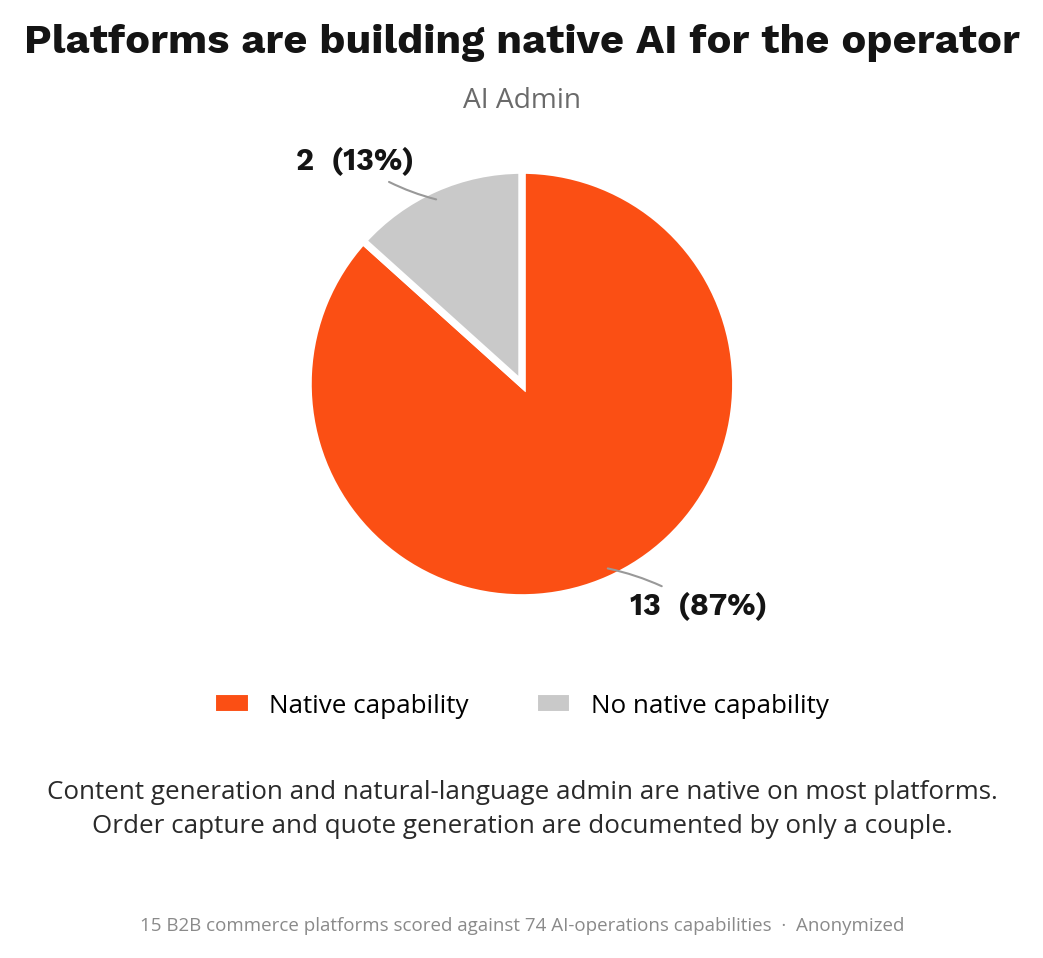
Start with the operator side, because this is where AI has genuinely arrived.
What AI Admin covers:
- Order and PO capture — extracting line items from documents, email, or spreadsheets, and matching them to your SKUs and customer part numbers
- Quote generation — drafting quotes from buyer requests, with pricing suggested from order history
- The natural-language admin agent — answering catalog and order questions, generating reports, performing updates
- Content generation and enrichment — product descriptions, attributes, categorization, SEO, translation, plus segmentation, tagging, and the standards that govern what gets published
What we found:
Content generation is everywhere. Twelve of fifteen platforms document AI that writes product descriptions, marketing copy, SEO metadata, and translations. It is the most common operational AI capability in B2B commerce by a wide margin.
The natural-language admin agent is close behind. Ten of fifteen document an assistant an operator can ask about catalog, orders, or reporting in plain language.
Operational capture is nearly absent. Two of fifteen document AI order or PO capture. One documents AI quote generation.
Look at that spread, because it tells you where the industry decided to point its AI.
Content generation is the visible work. It demos beautifully. It fills a screen with something a buyer might read. And it is real, most platforms can genuinely do it.
Order capture is the expensive work. It’s the inbound PO that arrives as a PDF attachment and gets keyed in by hand. The customer part number that doesn’t match your SKU. The pricing that has to be validated against that account’s contract before anything releases. That is the work that eats a CSR’s day, every day, and it is the thinnest part of the market.
The AI showed up to write product descriptions. In general, it’s not yet ready to do the operations.
That is not a knock on content generation, which is genuinely useful. But if your evaluation of a platform’s AI is impressed by generated descriptions, you are being shown the easy half. The question to ask is what happens to the PO that lands in the inbox at 4:45 on a Friday.
Can an agent even get in the door?
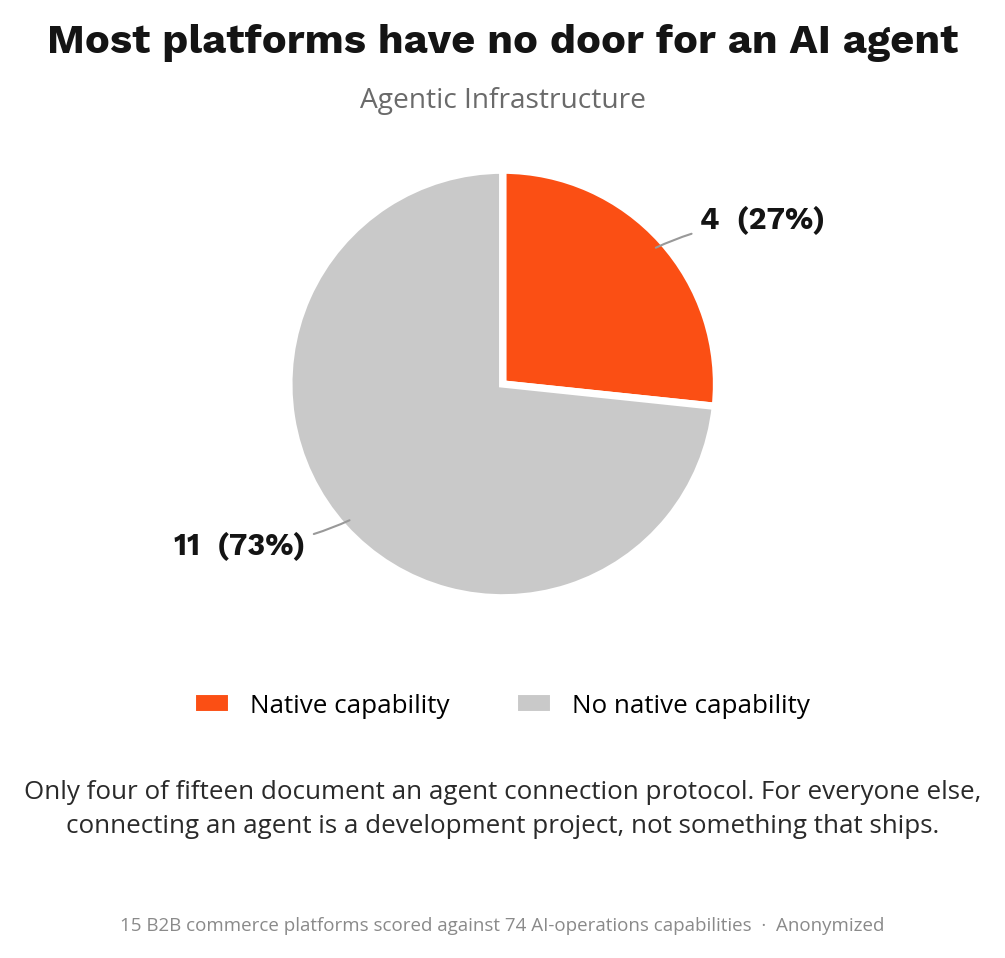
Now the other side. This is not a question of breadth. It is a gate, and almost nothing gets through it.
What Agentic Infrastructure covers:
- Agent connection protocols — the standard way an agent connects and discovers what it can do
- Data exposure — catalog, pricing, inventory, order history and quotes, and whether the agent sees contract pricing and the entitled catalog rather than list pricing and a generic one
- Agent actions — search, cart, submit an order, request and convert a quote, check status, reorder
- Authentication and governance — binding the agent to a specific buyer account and role, then holding it to spend limits, budgets, approval routing, and credential revocation
What we found:
First question: is there a door at all? Four of fifteen platforms document an agent connection protocol. One of those four exposes only documentation and API reference retrieval, not commerce objects, so an agent can read the manual but cannot touch a catalog or an order.
Second question, and this is the B2B one: can the agent be a buyer? This is where it collapses. Connecting an agent is one thing. Connecting an agent that acts as one of your customers is another entirely, and it is the only version that matters in B2B.
A B2B buyer is not a generic shopper. They belong to an account with negotiated contract pricing, an customer-specific catalog, role-based visibility, and an approval chain. In general, an agent that connects as an anonymous application gets none of that. It sees list pricing and a generic catalog, because the platform has no idea which customer it is acting for.
Binding an agent to a specific buyer account, with contract pricing and entitled catalog intact, is documented on one platform of the fifteen. On most of the rest the agent authenticates as an application against a tenant, not as a buyer against an account. Contract pricing does not apply to it. Entitlements do not apply to it. The account’s approval chain does not apply to it.
Third question: do the controls bind it? Here is the part that looks better than it is. Spend limits, budgets, approval routing, and credential revocation are broadly present across the market as mature B2B features. But they are inherited controls. They were built to govern people and they enforce on any authenticated client. Whether they bind an agent depends entirely on whether that agent routes through the same pipeline a human’s order would. And on most platforms there is no agent coming through that pipeline at all, because there is no door.
Strong governance, governing nothing.
The agentic conversation is running well ahead of the plumbing. And the B2B requirements, account identity, contract pricing, entitlements, approvals, are exactly where it thins.
What this means for a decision you make now
Here’s why this isn’t an abstract survey.
The platform you choose today will still be running when operational AI matures and agents actually plug in at scale. You are not buying for today’s AI maturity. You’re buying for whether this platform can do the operational work, and whether an agent can act as a real buyer when that starts to matter.
So three questions to take into the next vendor conversation.
What operational work does your AI actually do, beyond generating content? Ask about the inbound PO, the part number match, the contract price validation.
Can an agent connect through a real protocol (like MCP), without building the integration custom?
And can that agent act as one of our buyers, with their contract pricing, their entitled catalog, and their approval chain intact?
Ask those three. Watch how quickly “yes, we do all of that” turns into “let me check with the product team.”
The bigger picture
None of this is an argument against AI. It’s an argument for knowing what you’re actually buying, which is the one thing vendor marketing will never hand you.
Right now AI is the loudest thing in B2B commerce and the least pinned down. But that’s a familiar problem wearing a new label. The same distance between the claim and the delivery shows up in catalog, in search, in order management. Naming what a capability actually is remains the only way to get control of it.
Part one covered what your customer sees. This one covered what your team uses and what an agent can reach. The foundational layers are next, and the Fall report goes considerably deeper on all of it.
Once the capabilities are defined, the platforms can finally be compared on something real. We’re early in that work, but it’s started.
The infographic in this issue of The Digital Roadmap has the full picture.
Need help figuring out AI for your digital roadmap? Drop a line at info@b2b-squared.com or book a quick call.

0 Comments