
Separating the marketing from what really exists, and why the most-hyped idea in B2B commerce isn’t here yet.
Everyone’s talking about AI, from vendors to agencies and consultants. The term itself is creating exhaustion.
For 14 issues we’ve stayed out of the hype and focused on the other meaningful challenges we face as a community. But with some of the early noise behind us, it’s time to help make sense of what’s real, what’s hype, and what it means to you.
From what’s visible to the customer (semantic search, guided journeys) to agentic buying, one problem is evident: there is no definition. And that’s no different than order management, merchandising, or any other core B2B capability. When nothing is defined, marketing claims go unchecked. Every platform says “yes,” and the marketing wins by default.
This is the first of two or three blogs on AI in B2B commerce, this one focused entirely on the customer journey. From AI-assisted tools to a hard truth about agentic buying, the goal is simple: an objective read on what’s real, what’s hype, and how to interpret it today.
We’ll look at both sides of AI in the buyer journey, the AI that helps a person buy and the AI that buys on their behalf, through three simple questions: Is it real, does it know your customer, and can you control it? Let’s jump in.
Defining AI for commerce platforms
Before we scored a single vendor, we did the unglamorous part.
We defined the capabilities. Not in the abstract, and not from a vendor’s feature list. We built these capabilities in the same granular detail we have thousands of others for digital platforms, granular functionality that is objectively defined. In short, not just does it have the capability but, more important, how it’s supported.
This is the objectivity that in B2B moves past irrelevant analyst reports and vendor marketing to help you understand one question: Does it do it the way you need it?
For the customer-facing side of AI, that work produced eighty capabilities, defined from the ground up using our capability framework. Then, and only then, did we measure. We assessed fifteen B2B commerce platforms against all eighty, measured against what each vendor publicly stands behind today. Not marketing decks. Not announcement blogs. Not ‘coming soon.’
A word on what these scores are, and aren’t. This is a first pass, a verifiable starting point, not a final verdict. Vendors will be validating this scoring for our upcoming report in the Fall. But, for now, this is a high-confidence assessment of where the platforms are today.
This is the customer-facing layer only, the AI a customer can engage. The foundational pieces, the admin tools, the product-side AI, the integration plumbing underneath, are their own use cases and future blogs.
Two use cases, for two different buyers
Start with a distinction almost nobody draws, and everything downstream depends on it.
Customer-facing AI in B2B commerce splits along a hard line: AI that helps a human buy, and AI that lets an agent buy on the human’s behalf. These are different users, doing different jobs, and platforms handle them very differently. Getting this distinction right is what separates a real evaluation from a checkbox exercise. We defined two use cases to hold them.
Use case one: AI-Assisted Customer Experience. The platform’s own AI, helping a human buyer get their work done faster. This is everything the customer touches directly.
What it is: search that understands intent, recommendations, a conversational assistant, AI-assisted order actions.
What it measures: whether the AI interprets natural language, recommends against the buyer’s own account, answers questions, compares products, and helps build, reorder, and place orders.
The defining question for B2B: not “does it have AI,” but “how is the AI indexed, and how does it honor the relational aspects of your customer relationship, curated catalogs, contract pricing, segments, and the rest?”
Use case two: Agentic Procurement. An external AI agent buying on the customer’s behalf. This is the frontier, and a fundamentally different user.
What it is: the buyer’s own agent connecting into the platform through a protocol, to discover products, retrieve account-specific pricing, and transact.
What it measures: whether the platform can connect an agent, expose the right data, let it take actions like search-cart-submit, authenticate it as an authorized buyer, and govern what it’s allowed to do.
The hard part: the controls. An agent that can buy but can’t be bound by a spend limit or an approval chain isn’t a feature. It’s a liability.
Two use cases. Two buyers. One set of questions you can ask about either.
The Framework: Live, Contextual, Governed
Once the capabilities were defined, we needed a consistent way to read them. Three questions do the work. They apply to the human buyer and the agent alike, and any distributor or manufacturer can carry them into the next vendor call:
Is it Live? Does it ship and work today, and is it part of the customer experience on the platform?
Is it Contextual? How is AI indexed and grounded to the customer, their account, their contract, or is it running against a generic catalog with a chat window bolted on?
Is it Governed? Can you keep it safe, whether a person is driving or an agent is?
Here’s what happened when we held them up against what vendors say they ship today.
Is it Live?
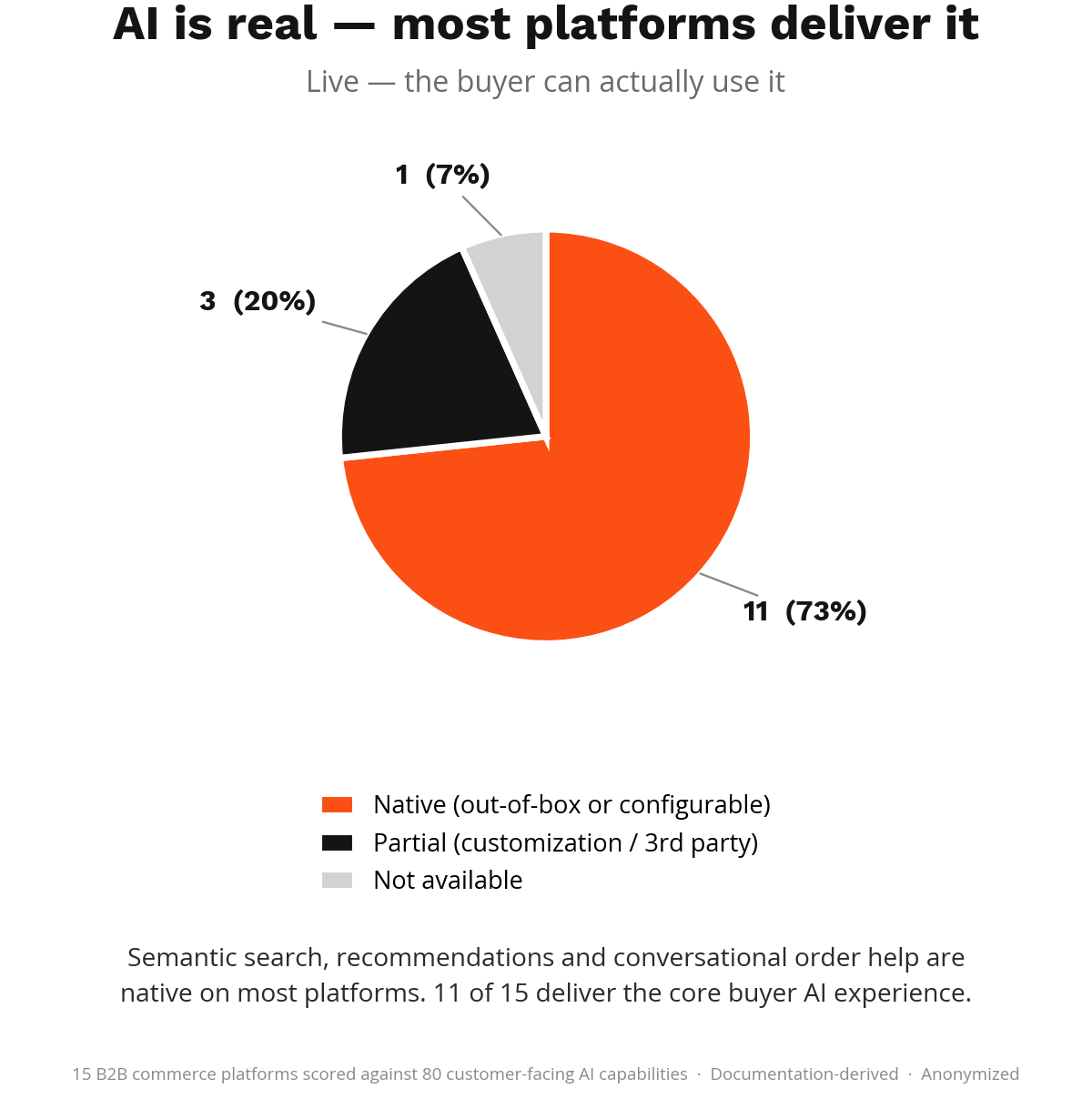
Live asks: What is available to assist the customer journey? It defines the specific functionality that exists today and that customers can engage with. To separate real access from a promise, we set the bar at native: does it ship as part of the platform, something the customer can turn on and run? Or is it something unavailable or requiring customization.
And a distinction worth naming: configurable is a good thing here, not a compromise. For the customer experience, you want to be able to shape AI, its data sources, how it ranks and shows results, how your merchandising feeds it. Native means the AI does the work and you keep control. What you don’t want is a capability that only exists as a customization project.
What Live covers:
- AI search and discovery, semantic search, intent, typo and synonym handling, guided results
- AI recommendations and product intelligence
- The conversational assistant, discovery, comparison, Q&A
- AI-assisted order actions, build, reorder, status, place
- On the agent side: connection protocols (MCP, A2A, UCP, AP2, REST) and agent actions (search, cart, submit)
What we found:
AI semantic search is real, but not universal. Fourteen of fifteen platforms say they offer it. Eleven have it natively. The other four are a third-party tool, a custom build, or nothing at all, so roughly a third of the market is claiming AI search it can’t natively deliver.
The agent protocols barely exist. The emerging standards (Agent2Agent, etc.) meant to let an outside agent plug in and transact are almost entirely absent. Most aren’t present on a single platform, and the one protocol, Model Context Protocol (MCP), with any real traction is native on just one platform. Six others can do it, but only as a custom build. Everywhere else it’s absent.
Platforms let AI read and assist, not act. A buyer can search, compare, and get help building an order.
The human-facing AI is real and reachable for much of the market. The agent-facing AI is where the roadmap starts.
Is it Contextual?
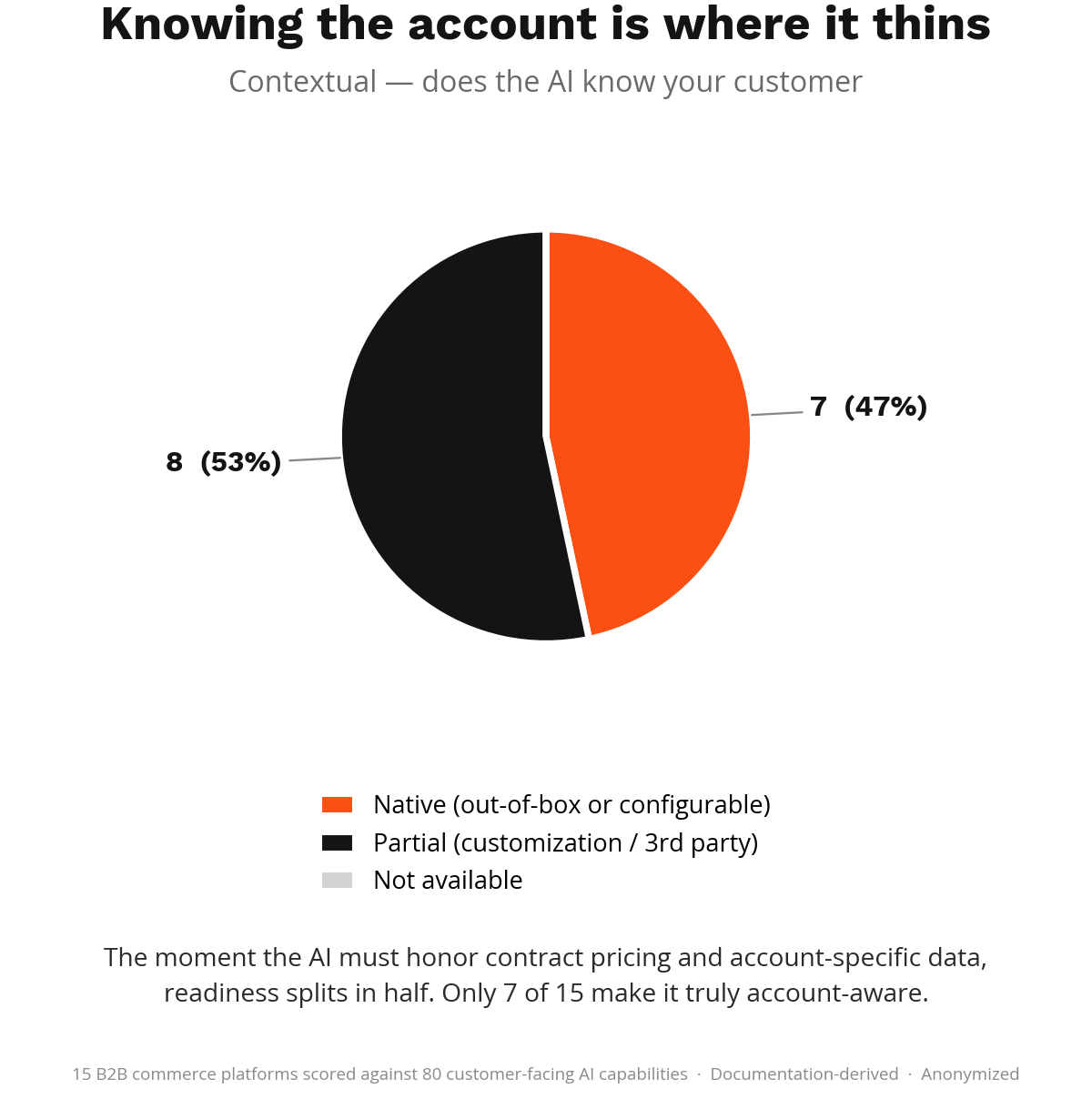
Contextual asks: Does the AI know your customer? Not the shopper, the account. This is the most B2B-specific test on the list, and the one that separates a demo from a deployment. In consumer commerce, “personalized” means the AI knows the person. In B2B, the person isn’t the unit of truth. The account is, with its negotiated contract, entitled catalog, market segment, credit position, and order history. An AI that knows the person but not the account is worse than useless. It’s confidently wrong.
And here’s a critical concept to understand, as it relates to B2B-driven AI functionality: indexing source. Contextual AI isn’t magic, and it isn’t really intelligence. It’s connectivity, whether the AI is indexed to the right account data, or whether it’s a generic engine dressed up in conversation. That’s the line between AI grounded in your data and AI that merely sounds smart.
What Contextual covers:
- Contract-specific and account-specific pricing, not just list pricing
- The entitled or curated catalog for that account
- Account-specific inventory and availability
- Buyer history and relationship data, substitutes, reorders, purchase patterns
- Segment- and role-aware responses
What we found:
Generic scores well, account-specific not so much. List pricing to an agent scores reasonably. The same agent seeing contract-specific pricing, the buyer’s real negotiated number, scores roughly half as much. Same capability, different data connection, half the readiness.
The pattern repeats everywhere. Generic catalog access is common; account-specific inventory is thin. A recommendation to a logged-in buyer scores well; one that knows that buyer’s substitutes or purchase history barely registers.
The intelligence is arriving. The connection to the customer’s real account data is lagging well behind it. In B2B, an AI that doesn’t know the account isn’t grounded in the data that matters most.
Is it Governed?
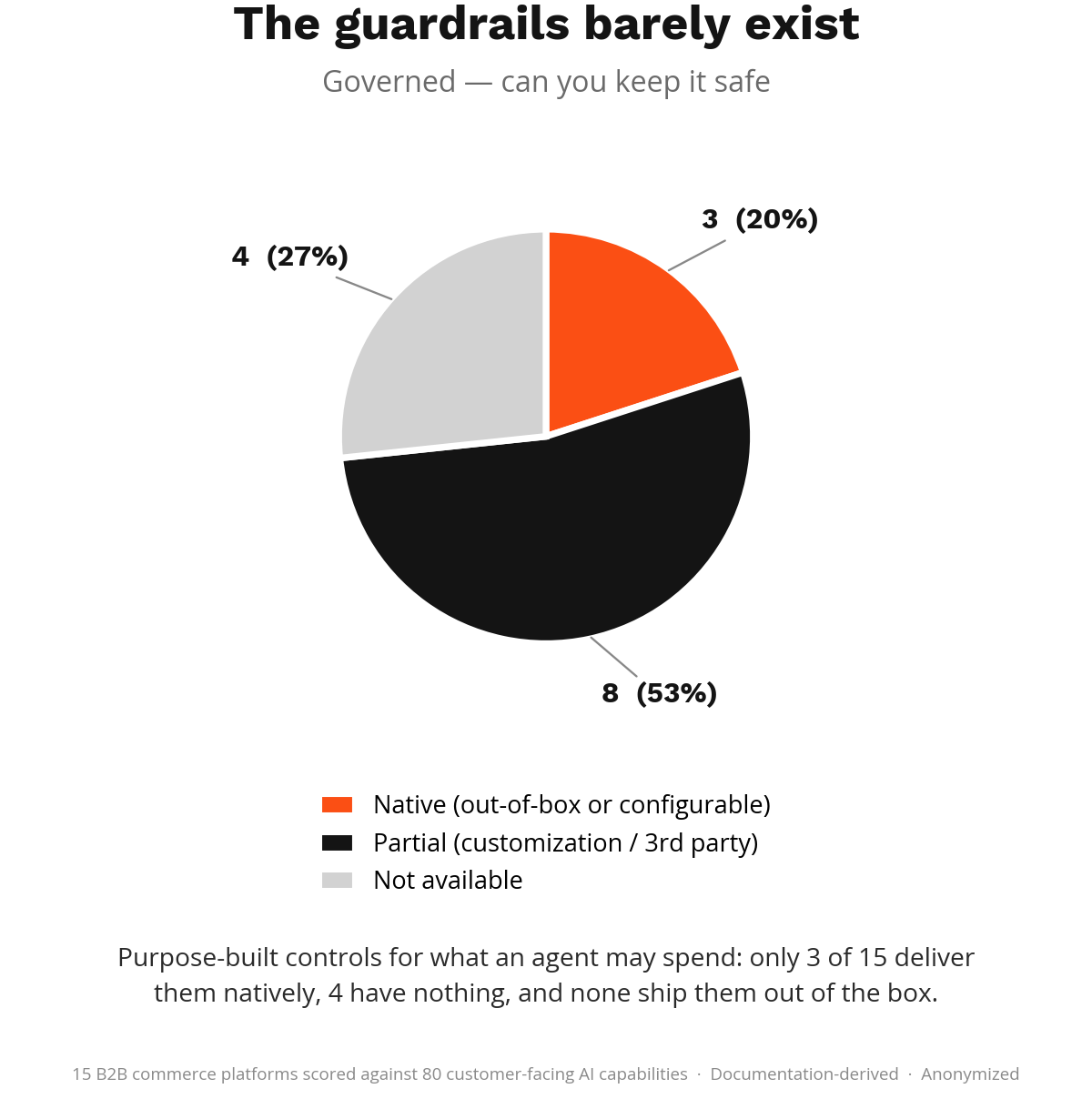
Governed asks: can you keep it safe? Can you control what the AI, or the agent, is allowed to do. It’s the test that matters most and shows up least, and it’s the one that turns “agentic buying” from a promise into a myth. An agent that can buy but can’t be bound by a spend limit or an approval chain isn’t a feature. It’s a liability.
What Governed covers:
- Spend limits, budgets, and approval workflows on an agent’s orders
- Agent authentication as an authorized buyer for a specific account
- Role and permission enforcement, read-only restriction, catalog and pricing visibility
- Activity logging and policy-violation flagging
What we found:
Agent-native spend controls don’t exist. From research across every platform reviewed, not one ships a native control for what an autonomous agent is allowed to spend. No agent budgets, no agent approval routing, no agent spend limits, no agent ship-to restrictions.
The assisted side is fine, because it inherits. When a human uses AI to place an order, it flows through the platform’s normal pipeline, so existing approval workflows, budgets, and spend limits bind it automatically. Those controls are real and mature, and they live in places like platform order management, not here.
The agent side is where control breaks. An external agent often bypasses that pipeline entirely, reaching data and actions directly, so the same controls don’t reach it. Telling an agent what it may see scores respectably; binding what it may spend sits at the floor of everything we measured.
So the platforms can tell an agent what to look at. But they can’t replicate a typical B2B order workflow.
Agentic buying isn’t being throttled by imagination. It’s being throttled by the absence of controls. An agent that has no B2B guardrails isn’t a buyer, it’s a liability. And, right now, a liability no one is solving for.
The empty roadmaps are the tell. If autonomous buying for B2B were anywhere in the near future, the guardrails would be getting built first. They aren’t. And if the buyers were asking for it, you can be sure it would be.
What this means for a decision you make now
Here’s why this isn’t an abstract survey.
The platform you choose today will still be running when agentic buying stops being a myth and starts being real. And it will, eventually. You are not buying for today’s AI maturity. You’re buying for whether this platform can make AI Live, Contextual, and Governed when the autonomy actually lands.
So the question was never “does it have AI.” Every vendor cleared that bar years ago, at least in the marketing. The questions that matter are the three you can now ask out loud, in the room, before you sign anything.
Is it Live, what AI-enabled tools assist the customer’s journey?
Is it Contextual, indexed to my customer’s real account and contract, or a generic engine that will confidently quote the wrong price?
Is it Governed, or is it DOA with your best customers?
Ask those three. Watch how quickly “yes, we do all of that” turns into “let me check with the product team.”
The bigger picture
We didn’t build this to sell you on AI. We built it to help you see it clearly, because clarity is the thing the market is missing and an accountability not found in vendor marketing campaigns.
AI is the loudest, least-defined capability in B2B commerce today. In truth, this same gap between what’s claimed and what’s delivered runs through product catalog, search, order management, every part of the eCom platform. The goal here was to help you define it, so you can begin to manage it.
And, this was just the first slice, the customer-facing layer. The foundational use cases come in the issues ahead next, with even more depth in our Fall report.
Defining the capabilities provides the first opportunity to score and comparatively evaluate the platforms. That effort has been meaningful but has just begun.
Don’t miss the infographic in this issue of The Digital Roadmap.
Need help figuring out AI for your digital roadmap, drop a line at info@b2b-squared.com or book a quick call.

0 Comments