
The M&A wave in B2B is stress-testing multi-store capabilities
When a vendor says their platform does “multi-store,” what are they actually selling you?
Most B2B leaders can’t answer that — until the day they need to deliver one digital experience across two legacy companies.
Last Fall, speaking in Scottsdale at B2B eCommerce world we started talking about the ‘gotchas’ that happen to distributors and manufactuers when not getting the requirements right before selecting the platform.
An distributor attendee shared a story during the session. Her company had gone to great length to build out a store that accounted for their complex customers and the way they manage them. But, as they started to stand up the 2nd store they learned something very unfortunate.
Their ‘multi-store’ eCom platform didn’t allow catalogs, account structures, workflows or anything else to be inherited by other stores. Essentially, every new store would have to built from scratch.
They thought they were launching a second store. What they actually did was rebuild from zero. I wish I could say this story was isolated, but I’ve seen it revealed many times.
IMO Multi-Store is the one place where platform architecture can cause the most pain. Depending on the platform architecture, additional channels and stores can be almost prohibitive to launch and support for many teams.
Every acquisition asks the same question
And the context of this is perhaps more timely than it’s ever been.
B2B is in the middle of an acquisition wave. Distribution and manufacturing are consolidating faster than most operating teams have ever seen — PE-led roll-ups, strategic acquisitions, brand portfolios growing every quarter. M&A is defining digital strategy in B2B right now.
And every acquisition asks the same question: how do we deliver one digital experience across the brands, channels and businesses we support?
The acquired company brings its own ordering workflows. Its own catalog structure. Its own customer base, with its own pricing, contracts, and expectations. Its own brand identity — which you paid for, because the brand is the asset.
The parent company wants to operate as one company: unified reporting, unified team, unified pipeline, unified cross-sell. The acquired customers want to keep buying the way they always have, from the brand they always trusted.
Both have to be true at once. That’s the unspoken bet of every B2B acquisition.
Multi-store is the architecture that delivers — or doesn’t
This is where multi-store stops being a feature on a vendor’s checklist and becomes the architecture that decides whether the acquisition pays back.
For many brand-centric B2B distributors and manufacturers this will become a defining opportunity or challenge of the go-forward acquisition strategy. When multi-store works right, lots of options are on the table.
When multi-store fails, you do what most companies do: pick one platform, force-migrate the acquired customers, and watch them churn. Or run two platforms in parallel, build glue between them, and burn 18 months on integration that was never supposed to be the value driver of the deal.
This is also what every other channel move looks like — a new regional storefront, a DTC channel alongside dealers, a sub-brand carved out for a segment. Same operating challenge, less urgency. M&A is just the version with a deal clock attached.
Multi-store isn’t one capability. It’s three.
Multi-store breaks down into three jobs. Most platforms can only do one of them well.
Job 1 — Store Provisioning. Stand up a new store from the admin without a development project. This is the mechanical work everyone pictures when they hear “multi-store” — getting the acquired brand’s storefront live with the right catalog, the right look, and the right routing. It’s the most visible part of multi-store, which is why every vendor demos it confidently. It’s also the easiest job to fake. A platform can look strong here while quietly failing at the next two. 9 of 18 platforms hit median or greater here.
Job 2 — Cross-Store Administration. Operate every store from one admin once they’re live. This is where the daily reality of running multi-store actually lives — for the CSRs taking orders across stores, the merchandisers updating catalogs, the store admins managing local pricing. It requires unified role management and store-scoped permissions. When this job is broken, your team ends up logging into multiple admins and copying changes by hand. 12 of 18 hit median — the most reliable job in aggregate.
Job 3 — Cross-Store Identity. Customers, companies, and users spanning multiple stores. This is the hardest job and the one that breaks M&A integrations. It’s not whether a customer can log in across stores — it’s whether B2B parent/subsidiary relationships, customer groups, and user roles travel with the customer as your portfolio expands, natively, without custom integration. Most platforms can demo a shared login. Few can deliver a corporate hierarchy operating across stores out of the box. 11 of 18 hit median — but the drop to the bottom tier is the steepest of any job.
B2B Platforms & Multi-Store
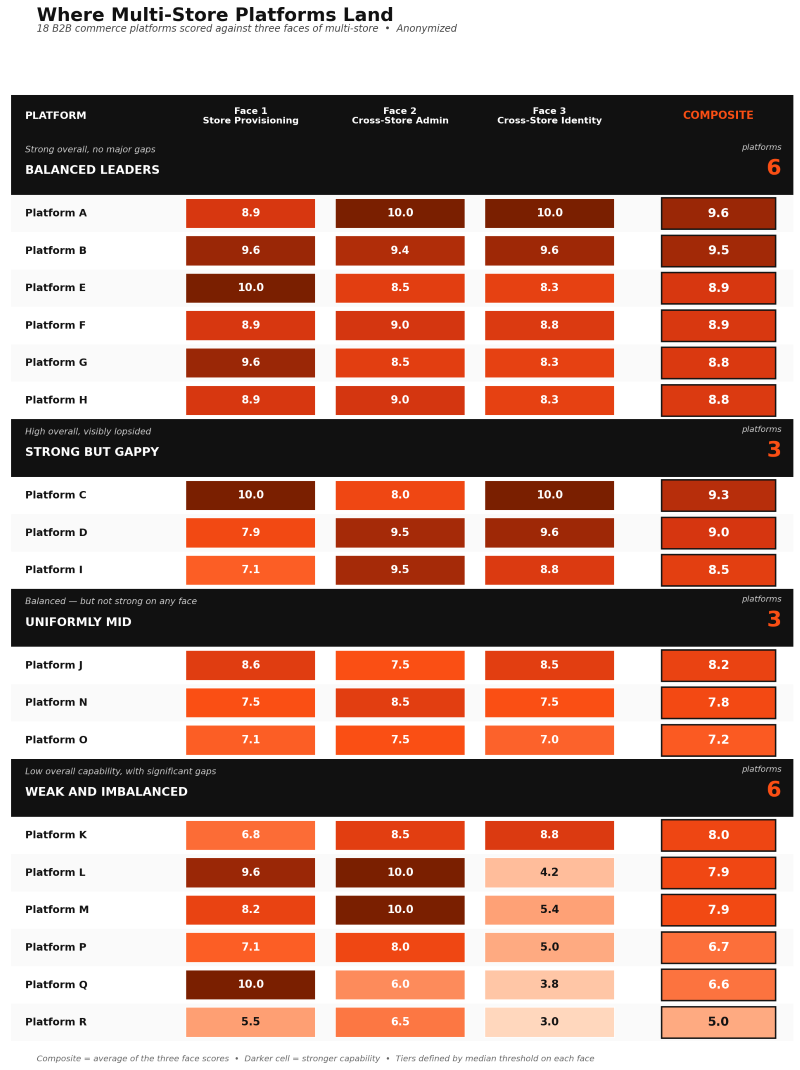
In past RFPs we’ve scored 18 B2B eCommerce platforms — the names you’d expect — against the three jobs of multi-store. Scores combine vendor self-attestation where available with documentation-based evaluation for the rest.
Only 6 of 18 — one in three — meet or exceed median capability across all three jobs.
Read that again. The platforms most B2B companies are evaluating, demoing, or running on right now are mostly not architected for what their executives are about to ask of them in the next deal.
We grouped them into four tiers:
Balanced Leaders — six platforms. Strong across all three jobs. These handle acquisition integration and multi-brand operations without falling over. Not always the loudest in your demo cycle. But the data is consistent.
Strong but Gaps exist — three platforms. High overall, visibly lopsided on at least one job. Usable. But you’re making a trade-off. Know which job you’re trading before you sign.
Uniformly Mid — three platforms. Balanced but not strong anywhere. No major gaps, no major strengths. Probably fine for one store. Probably suspect for three.
Weak and Imbalanced — six platforms. Low overall and lopsided. This is where the dramatic cases live — platforms that look great in the demo for Job 1 (because Job 1 demos well) but collapse when you ask about Job 2 or Job 3. The Demo Champion problem.
Identity is where M&A value lives or dies
If you take one thing from this issue, take this:
Job 3 — Cross-Store Identity — is where M&A value lives or dies.
The asset you paid for in an acquisition isn’t the brand on the box. It’s the customer relationships behind it. Being able to carry customers, accounts and other relationships across multiple stores accomplishes what many mergers set out to do.
Identity is also the job where the gap doesn’t show up until you’re 12 months past close, looking at acquired-customer churn nobody can explain. It’s the hardest to retrofit. And it’s the job nobody asks about in the demo.
What to ask before you sign
If you take this to your next vendor meeting, ask three questions:
- Show me how I create a second store with product catalog from the admin. Not in a sandbox. In a live environment.
- Show me how I assign a role that can edit Store A but not Store B. Not as a configuration option on a slide. In the actual product.
- Show me a customer record that exists across multiple stores natively. Not via a workaround. Not via “we’ll customize that.” Natively.
Your ability to deliver on brand and channel opportunities will be predicated at least in part, on the answers to those questions.
Before your next acquisition
The cautionary tale learned in Scottsdale wasn’t because a mistake was made in implementation. It was due to a gap between requirements and capabilities in evaluating multi-store capabilities. What she got was a single-store platform, deployable twice.
That difference will matter more next year, and more the year after. Every deal in the consolidation wave makes it more acute.
The first step is knowing where your operation actually sits. Which job will hurt you most? Where are the gaps? Where can you afford to trade?
We built a quick diagnostic to map your own multi-store profile across the three jobs in about 10 minutes (included in Issue 12 newsletter archive). If you’re staring down an acquisition — yours, or one happening to you — start there.
Lost in digital? Let us know how we can help (info@b2b-squared.com).

0 Comments