
Order orchestration is the next test of your eCommerce platform. Here’s what 18 B2B platforms actually deliver.
The order management system at most B2B companies isn’t a system. It’s a person (or people).
A CSR who knows which branch has stock today. A branch employee who knows which customer can get the expedite. A warehouse manager who knows which transfers make sense and which don’t.
The institutional knowledge that holds it all together lives in their heads, walks out the door at 5 PM, and gets reinvented every time someone retires or quits.
This is why no one ever suggests they have an ‘order management problem’. Because order management is solved — it’s running on people.
A few issues back, I wrote about the order management problem hiding in plain sight — the manual workarounds, the rules that live in tribal memory, the customers who’ve learned not to ask.
This piece is the follow-up.
The question this time isn’t do you have a problem. The question is what does it look like to actually solve it in your eCommerce platform?
The answer has a name: order orchestration. And recent data from the Platform Genius™ scoring model shows how few B2B platforms actually deliver it.
Order management vs. order orchestration
These get conflated. They shouldn’t.
Order management is largely coordinated or managed by ERP as a Source of Truth. It records the order, allocates inventory, prints the pick list, generates the invoice. It’s the system of record.
Order orchestration is everything that has to happen between a customer wanting something and your ERP getting a clean order. The routing logic. The branch selection. The fulfillment trade-offs. The choice of how, when, and from where.
In most B2B companies today, that orchestration is done by people. The CSR who routes the order. The branch employee who calls another branch to check stock. The salesperson who flags a customer as “VIP, expedite this one.” Order orchestration in eCommerce is what replaces all of that — and ideally, hands the decision to the customer to make in real time.
It’s not a separate platform.
It’s a set of capabilities your eCommerce platform either has or doesn’t.
The three jobs of order orchestration
Order orchestration has three jobs. Get all three right and the customer stops calling and starts managing it themselves. Get any one wrong and your CSRs are still doing the orchestration manually.
Configure — the admin builds the rules. Order routing logic. Branch priorities. Allocation tiers. Fulfillment method definitions. The institutional knowledge gets encoded into the platform.
Surface — the customer sees what’s possible. Real-time branch inventory. Order status. Pickup-ready times. Fulfillment options at checkout, with the trade-offs visible. The customer can see the same picture your CSR sees.
Decide — the customer drives the outcome. Pick up at the home branch tomorrow, or at the branch with stock today. Wait two days for standard, or pay more for the afternoon delivery. Consolidate a split order into a single pickup. The customer makes the call, and the platform executes on it.
The first two jobs scale what your CSRs do today. The third is the B2C-type customer experience few B2B companies can actually deliver.
What 18 B2B platforms can actually do
We scored 18 leading B2B eCommerce platforms against 85 order orchestration requirements in some recent Platform Genius RFPs. Three jobs, one threshold. The results are not what most vendors would want you to know.
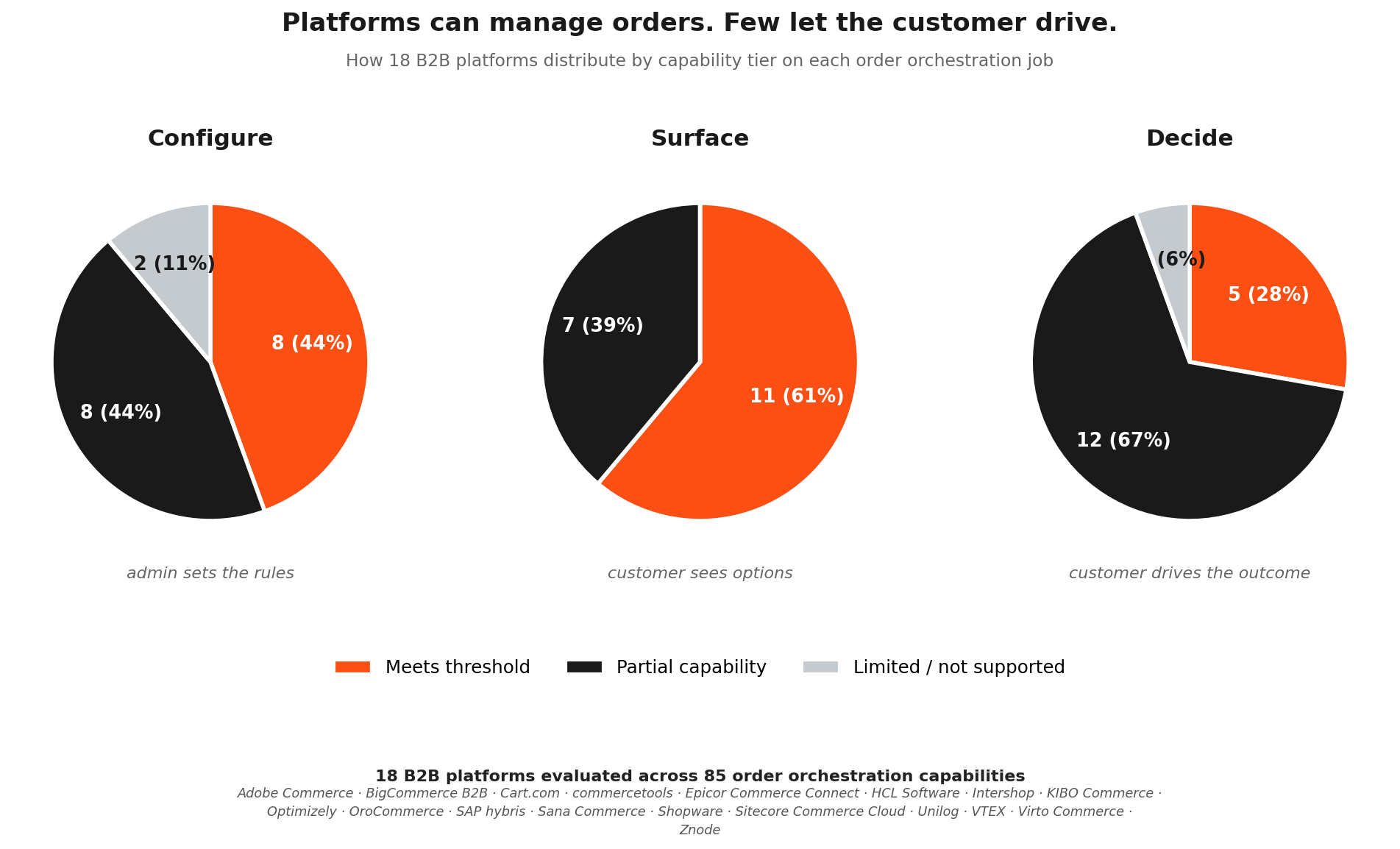
Three things stand out.
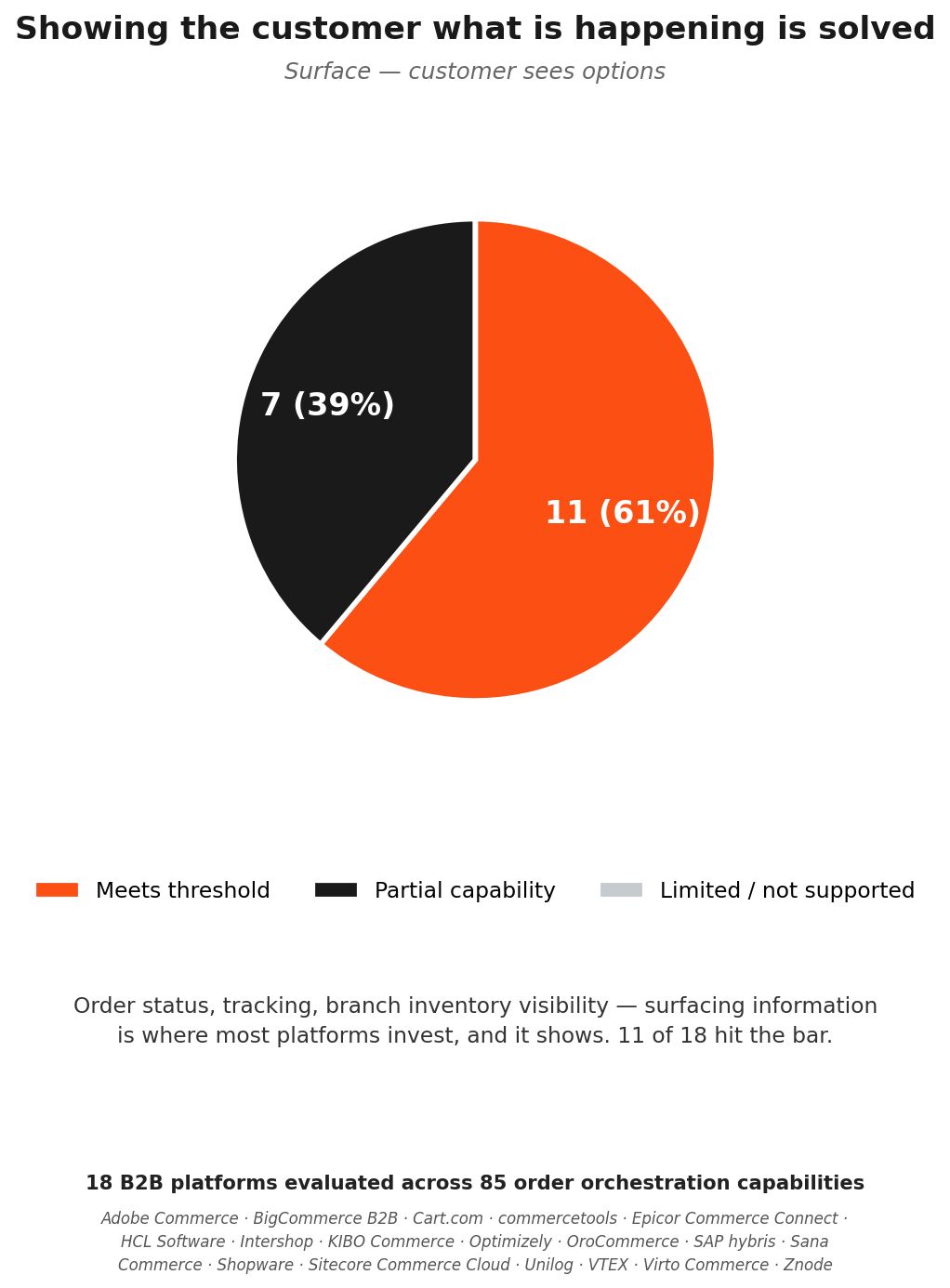
Surface is largely solved. Eleven of 18 platforms meet the bar for showing the customer what’s happening — order status, branch inventory, tracking. The industry has invested here, and it shows.
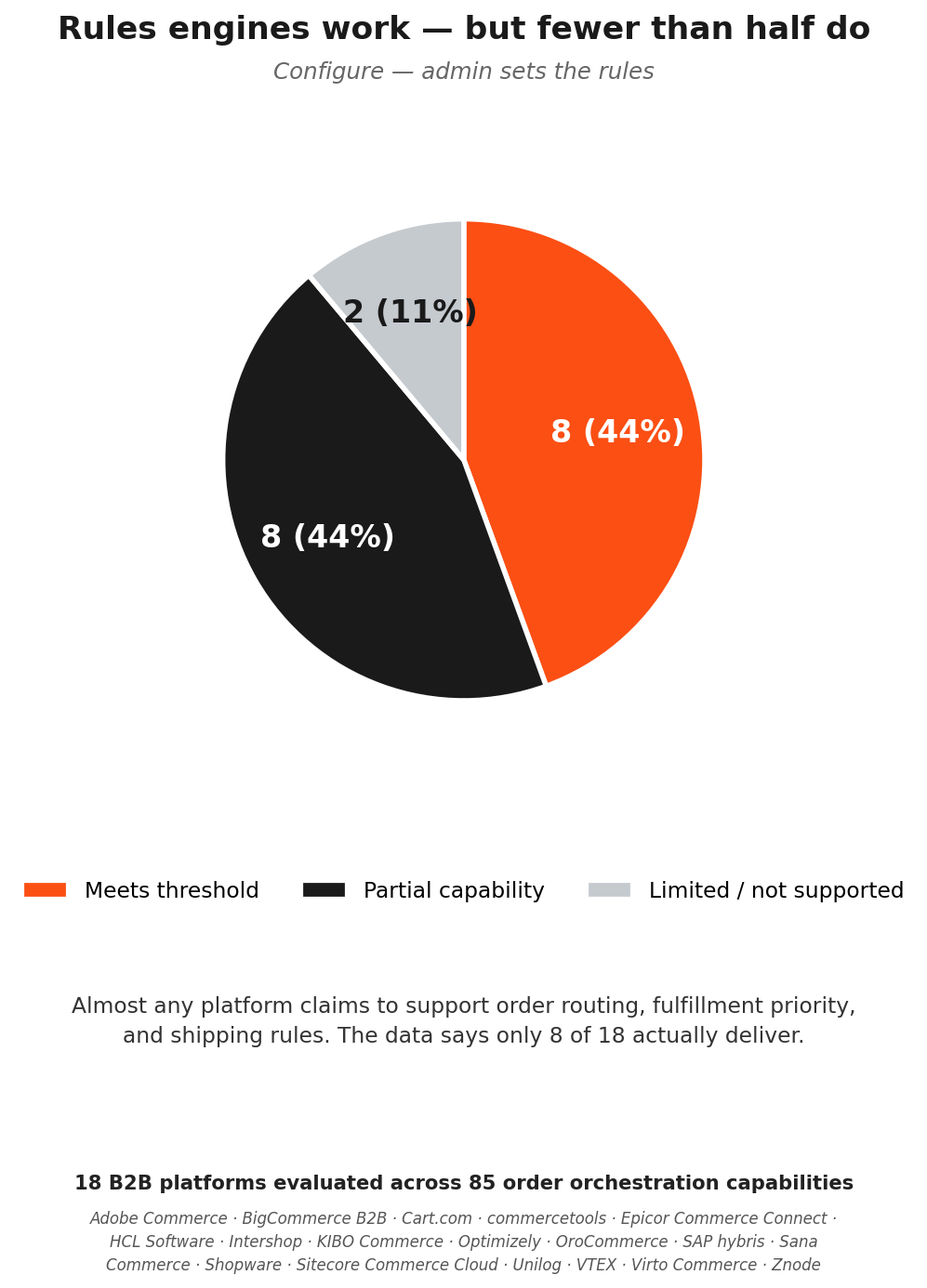
Configure is a mixed bag. Only 8 of 18 actually deliver the routing, branch, and rules logic at the level the data calls for. Almost every vendor says yes to these requirements. The data says fewer than half do.
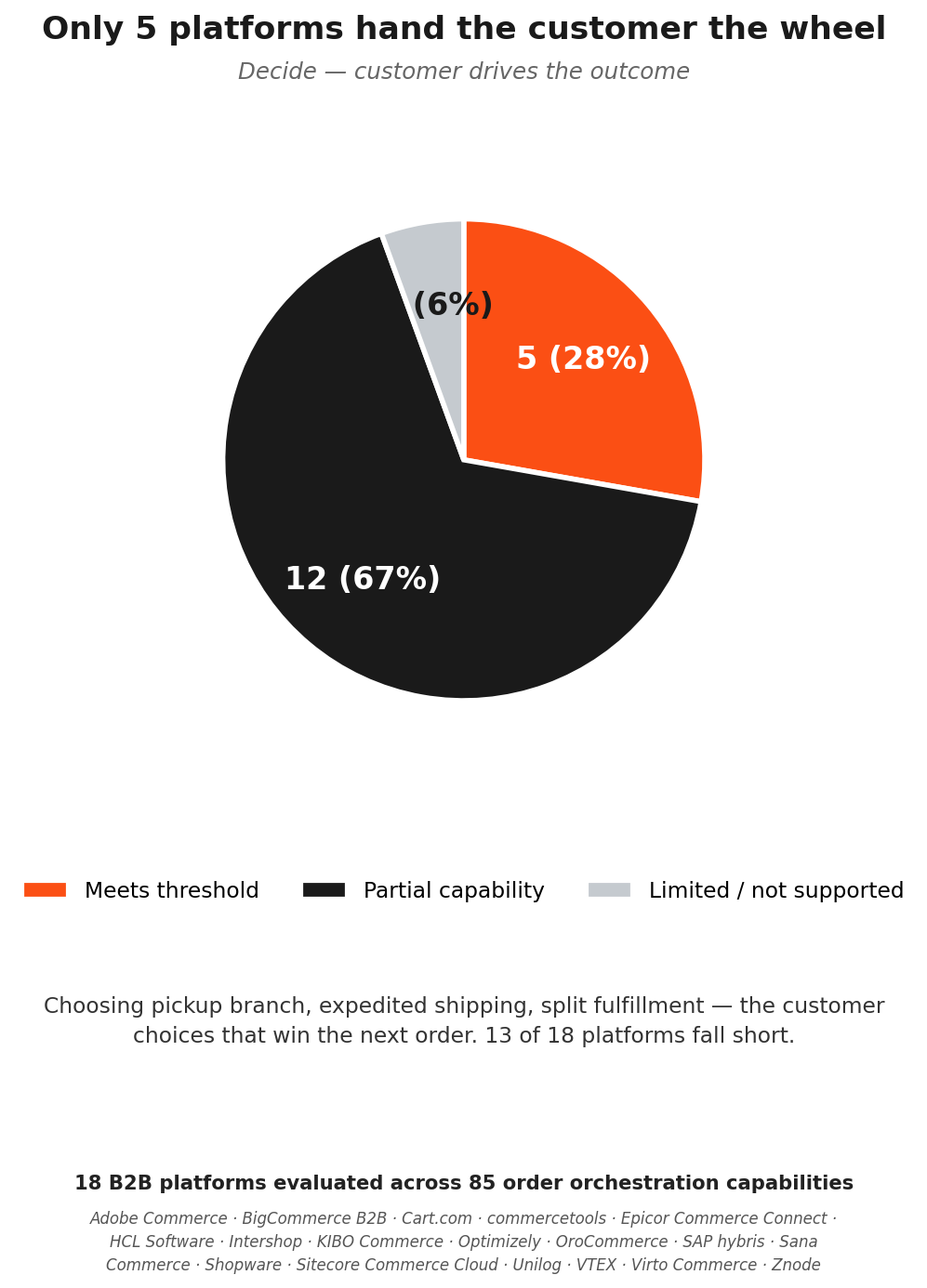
Decide is where it falls apart. Only 5 of 18 platforms — fewer than 1 in 3 — actually let the customer drive the fulfillment decision themselves. The capabilities that win the next order are the ones most platforms are weakest on.
That last finding is the story.
Let’s go through each job and what it actually takes.
Configure: admin sets the rules
This is what your CSRs do today. They hold the routing rules in their heads. Configure is about encoding that knowledge into the platform so it executes the same way every time, at scale, without anyone having to think about it.
What you want. When a customer places an order:
- The platform decides which branch fulfills which lines
- The platform knows which customers get priority on tight inventory
- The platform initiates a branch-to-branch transfer when the home branch is short
- The platform applies the right shipping method based on customer, geography, and product mix
- A CSR can override the rules when needed — without breaking the system
What you’ll need. A working rules engine. Multi-node inventory visibility. Customer-to-branch relationships. Allocation logic tied to customer segmentation. Configurable transfer workflows. The ability for non-developers to change rules without filing a ticket.
Almost every B2B platform claims to support this. The 8 of 18 that actually do — that’s the question to ask in your next demo.
Surface: customer sees status
This is where the industry has invested, and it shows. Order status pages. Tracking integrations. Inventory visibility. Most platforms have gotten the basics right.
But “the basics” isn’t “great.”
What you want. The customer can answer their own questions:
- Is my order ready? When will it ship?
- Is the item I need available at my home branch right now?
- Can I see real-time inventory across nearby branches?
- What are my pickup options, and when can I pick up?
- If this is a split order, what does that actually mean for my delivery?
What you’ll need. Real-time inventory feeds. ERP-integrated status mapping. Branch metadata exposed to the storefront. A clear UX that presents trade-offs without revealing internal logistics complexity. The platform has to talk to the systems that hold the truth.
Eleven of 18 platforms meet the bar here. The gap from those 11 to the other 7 isn’t usually a capability gap — it’s an integration gap. The platform can technically display the data, but only after a six-figure custom build to pipe it in.
The good news: this is the most solved of the three.
The bad news: most platforms stop here.
Decide: customer drives the outcome
Here’s where the rubber meets the road.
And here’s where most platforms fail.
In B2C, this is table stakes. You buy from Best Buy online and the site asks you: ship to home, or pick up at the store today? Pay more for delivery tomorrow, or wait three days for standard? Split this into two shipments, or wait for everything to be ready? The customer makes the call. The retailer executes.
In B2B, that decision still happens — but it happens on the phone. The customer calls the CSR. The CSR checks three systems. The CSR offers two options. The customer picks one. The CSR types it into the ERP. Six minutes per order. Multiply that across your call volume.
What you want. At checkout, the customer can:
- Choose to pick up at the home branch, the branch with stock today, or any other branch
- Choose between standard shipping, expedited shipping, or branch pickup for the same line items
- Consolidate a split order into a single branch via transfer — and see the cost and time impact
- Get a clear “ready by” time for pickup orders
- See real-time inventory at the branch level when making the choice
What you’ll need. All of Configure. The rules have to exist. All of Surface. The data has to be visible. Plus: workflows that let the customer act on the data, pricing logic tied to fulfillment method, and the platform’s willingness to honor the customer’s choice through to execution.
This is where 13 of 18 platforms fall short — and, in all honesty, as we capture more data points with Platform Genius, I expect this gap to grow even greater. Some of them have the inventory data. Some of them have the rules engine. Almost none of them put the steering wheel in front of the customer.
The 5 platforms that do these better than most natively? Probably worth investigation.
What your gaps reveal
The pattern across the three jobs tells you something different than any single job in isolation.
Strong Configure, weak Surface and Decide. This is a platform built for the back office. Your CSRs will love it. Your customers will keep calling them. You’ll scale by adding people.
Strong Surface, weak Configure and Decide. This is a platform that looks great in a demo. The status pages are slick. The customer can see everything. They just can’t do anything about what they see.
Strong Configure and Surface, weak Decide. This is the most common pattern in B2B platforms today. The infrastructure is there. The data is there. The handoff to the customer is missing. The investment to close the last mile is usually substantial — and usually surprises everyone in year two.
Strong across all three. This is the platform built around what B2B customers want most: Self-service. The data says this is rare.
The bottom line
Most RFPs ask the wrong question.
They ask about order management capabilities in general terms. Every vendor will say ‘yes’.
The right question — the one the data above tells you to ask — is:
Can my customer drive the fulfillment decision themselves, in real time, without calling anyone?
If the answer is no, this is what order orchestration is about. The alternative is an order capture tool with manual orchestration bolted on. And the manual part is your CSRs, your branch employees, and the institutional knowledge that’s going to walk out the door eventually.
When you ask the right question, the data says 5 of 18 platforms can actually deliver anywhere near customer requirements.
The other 13 might tell you they can, which is why you’ll want to dig deeper if you’re looking to re-platform.
If you’d like to know how the platforms you’re currently evaluating perform against the Configure / Surface / Decide order management framework, drop us a line. And don’t miss the Do You Need OMS? evaluation tool in this week’s Digital Roadmap Newsletter.

0 Comments