B2B eCommerce RFP
DIY
How to Select a B2B eCommerce Platform — and Avoid the 'Gotchas'
Why Most Platform Selections Fail
Two-thirds of B2B companies are unhappy with their commerce platform — and the reasons are almost always the same handful of avoidable mistakes. This guide walks through how to select a B2B eCommerce platform the right way, plus the 5 gotchas that derail nearly every selection that goes wrong.
Most organizations approach selection backwards. They start with vendor demos. They chase feature checklists. They rely on analyst reports written for any-company-anywhere. The result: expensive platforms that don’t fit, custom development that wasn’t budgeted, and implementations that drag for years. Hidden costs include 3–4 years lost on the wrong platform, customer satisfaction eroded by poor experiences, and competitors moving ahead while you re-platform.
The fundamental issue: most companies don’t know what they actually need until after they’ve already bought the wrong platform.
The framework B2B Squared formalized as Capability Matching Method reverses the traditional approach. Instead of starting with technology and forcing your business to adapt, you start with your customers and your organization, then find the platform that actually fits. Eight stages. Each builds on the last. Skip a stage and the gaps compound — that’s where the gotchas live.
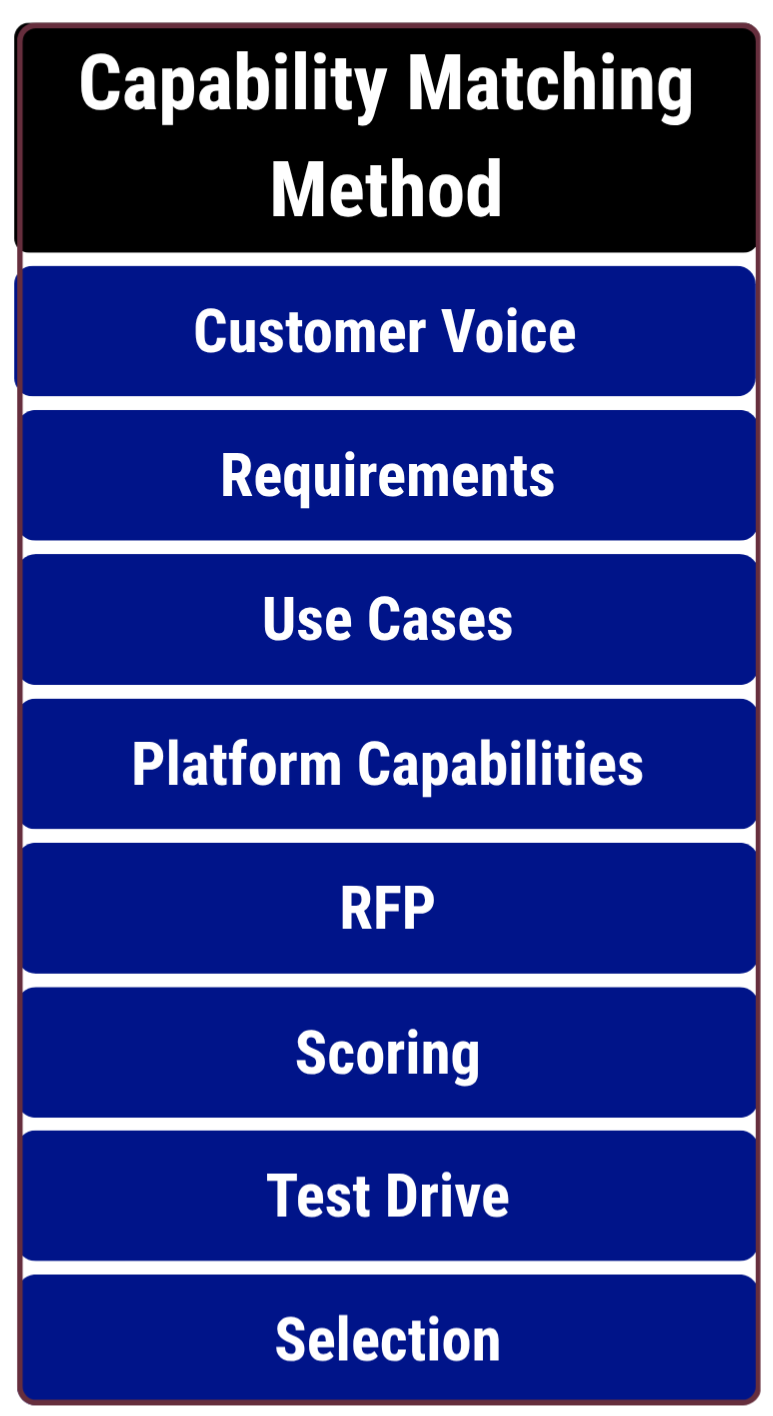
The 8 Stages of Selecting a B2B eCommerce Platform
- Customer Voice — Capture what your customers actually need
- Requirements — Translate insights into business, organizational, and technical requirements
- Use Cases — Document how real users will interact with the platform
- Platform Capabilities — Turn requirements into measurable, scoreable capabilities
- RFP — Engage vendors with real scenarios, not feature lists
- Scoring — Compare platforms by capability, not by pitch
- Test Drive — See platforms perform with YOUR use cases
- Selection — Synthesize the data, negotiate, decide
The full process takes most organizations ~12+ months. Done well, it prevents the multi-million-dollar mistakes that come from rushing decisions based on vendor presentations and feature checklists.
Vendors were lying so we’d spend $100K on software, telling us features were ‘out of the box’ without mentioning the extra $75k it would take to implement them.
Stage 1 — Customer Voice
What it is: Direct customer research that captures real digital experience requirements from the people who will actually use the platform. Beyond surveys — structured interviews, contextual inquiry, watching customers work.
Keys to success:
- One-Customer Approach. Focus on your best, most complex customers first. Solving for them sets you up with everyone else.
- Segmentation. Interview across major segments, account sizes, and buying behaviors.
- Job-to-Be-Done. Discover what customers are actually trying to accomplish — not what features they think they want.
Why it matters: Without direct customer input, you’re building on internal assumptions. The most common selection failure is choosing technology that delights executives but frustrates the customers who use it daily.
Stage 2 — Requirements
What it is: Translation of customer voice insights — plus internal organizational, business, and technical realities — into a comprehensive requirements document. The bridge between “what we heard” and “what the platform needs to do.”
Keys to success:
- Cross-Functional Input. Engage every team that touches the customer journey — sales, customer service, operations, finance, IT — to capture their needs alongside the customer’s.
- Future-State Focus. Design for where you want to be, not what you have today.
- Business Rules & Logic. Capture pricing logic, approval workflows, account hierarchies, fulfillment rules, and any industry-specific protocols the platform must accommodate.
- Technical Boundaries. Document integration requirements (ERP, CRM, PIM, OMS), security requirements, and infrastructure constraints up front.
Why it matters: Without complete requirements, you’ll evaluate platforms against half the picture. The hidden requirements — the ones nobody documented because “everyone knows” — are exactly where post-launch failures live.
Stage 3 — Use Cases
What it is: Detailed use case documentation describing how different user types interact with the platform across real scenarios. The bridge between requirements and granular evaluation.
Keys to success:
- Persona-Driven. Build use cases for each user type: customers, CSRs, sales reps, ops, admins.
- Scenario Specificity. Document edge cases and complex scenarios, not just happy-path transactions.
- Business Context. Connect use cases to business outcomes (revenue impact, cost reduction, efficiency gains) where possible.
Why it matters: Vendors can claim “we do B2B” without understanding the dozens of specific ways your customers place orders. Use cases force the specificity that prevents “yes, we do that” from becoming “that requires custom development” after the contract is signed.
Stage 4 — Platform Capabilities
What it is: Translation of use cases into objective, measurable platform capabilities. The largest gap in traditional evaluation — and the foundation of objective scoring.
Keys to success:
- Granular Decomposition. Broad user stories get broken into detailed requirements matched to specific platform logic.
- Technical and Business Context. Include both technical attributes (APIs, data models) and business functionality (admin interfaces, configuration tools).
- Out-of-the-Box vs. Configuration. Account for what’s truly native versus what requires plugins, custom development, or workarounds.
Why it matters: This is where platforms separate themselves. A demo can show a polished interface while hiding that your specific requirement needs six months of custom development. Granular mapping reveals the truth before the contract.
Stage 5 — Request for Proposal (RFP)
What it is: A well-constructed RFP that goes beyond features to present use cases, detailed requirements, current state, and evaluation criteria. The validation point where vendors prove capability or admit gaps.
Keys to success:
- Use Case Presentation. Provide vendors with actual customer scenarios and workflows to evaluate against.
- Project Context. Vendors need the “what” and “why” — not just requirements.
- Integration Architecture. Provide diagrams showing how the platform must fit into your existing stack.
- Criteria Summary. Define what your scoring values mean (e.g., what counts as “out of the box” versus “configurable”).
Why it matters: Most RFPs invite generic marketing responses. A use-case-based RFP forces vendors to prove capability or admit gaps — before you’re locked in. Mis-aligned vendors actually opt themselves out, saving you the time of evaluating them.
Stage 6 — Scoring
What it is: A weighted scoring system that translates hundreds of granular requirements into comparable platform scores. Visibility at both micro (capability-by-capability) and macro (overall fit) levels.
Keys to success:
- Requirement Prioritization. Weight requirements by customer impact, business value, and organizational capability — not all requirements are equal.
- Capability Scoring Standards. Establish consistent evaluation criteria: native, configuration, plugin, custom, impossible.
- Stakeholder Reporting. Build reporting that gives team-level visibility (micro) and leadership rollup (macro).
Why it matters: In the binary “yes/no” world of typical RFPs, vendors have massive leeway. Forcing platforms to demonstrate HOW they deliver solves comparative visibility, stakeholder reporting, and Total Cost of Ownership in one move. Removes bias, provides defensibility.
Stage 7 — Test Drive
What it is: Where most platform selections go wrong. Vendors deliver polished, friction-less, customized demos that don’t represent your reality or your TCO. The radical alternative: structured Test Drives using YOUR use cases.
Keys to success:
- Test Drive, Not Demo. Demos are vendor-controlled. Test Drives flip the script — vendors arrive with out-of-the-box software and demonstrate YOUR use cases.
- Process vs. Outcomes. Vendors are accustomed to showing the finished experience. Make them show HOW it gets built.
- Live Scoring. Provide team members with a structured document to score the efficacy and elegance of what vendors actually demonstrate.
Why it matters: The platform that looks perfect in the demo often becomes a nightmare in implementation because the demo environment bore no resemblance to what you actually purchased. Test Drives reveal what’s truly out-of-the-box and where customization will be required — before you sign.
Stage 8— Selection
What it is: The final decision phase. Synthesizing scoring, Test Drive feedback, and Total Cost of Ownership into a single defensible choice — and translating that choice into a contract that protects you.
Keys to success:
- Stakeholder Synthesis. Bring together micro-level (team-specific) and macro-level (leadership) views into one clear narrative — the same data points proving fit to the CEO and to the team that will use the platform daily.
- Total Cost of Ownership. Include licensing, implementation, customization, training, ongoing maintenance, and integration costs across at least three years.
- Negotiation Leverage. Vendors who scored well know they won; vendors who came close know they almost won. Use the competitive dynamic to sharpen pricing and contract terms before signing.
Why it matters: Even after rigorous scoring, the final selection is where political and emotional factors creep back in. A structured selection phase tied to the customer voice and use case work keeps the decision tethered to objective fit — and turns the scoring rigor into actual negotiating leverage with the chosen vendor.
The 'Gotchas' Every Buyer Faces
Even with a good framework, the same mistakes show up selection after selection. Watch for these:
1. “Out of the box” claims that aren’t. Vendors say “yes, we do that” without specifying what’s native, what’s configurable, what’s plugin-based, and what requires custom development. The result is six-figure customization surprises after contract.
2. Demos that don’t match the platform you’ll buy. The demo environment is often a polished, customized version that bears little resemblance to the actual product. You’re buying the pitch, not the platform.
3. Capability gaps surfaced at implementation, not selection. A capability that scored “yes” in the RFP turns into “yes, with these workarounds” once you’re building. Your bill grows.
4. Customer adoption struggles. The platform that delights executives in demos can frustrate the customers and CSRs who use it daily. If Customer Voice was skipped, this gap is invisible until launch.
5. Integration costs that weren’t budgeted. Every B2B platform integrates with something — ERP, CRM, PIM, OMS. “We have an API” doesn’t mean integration will be cheap, fast, or reliable. Surface integration depth in the RFP, not the implementation kickoff.
When to Run This Yourself vs Getting Help
You can run a B2B eCommerce platform selection internally. Many distributors try. The honest assessment:
DIY makes sense if your business is relatively simple, your team has bandwidth (this isn’t a side project), you have internal expertise across all 8 stages, and a 6–12 month timeline is acceptable.
Get help if your business is complex (multi-DC, customer hierarchies, deep catalogs, intricate fulfillment logic), your team has day jobs and can’t dedicate months, you need internal defensibility for a multi-million-dollar decision, or you want comprehensive platform coverage rather than just the vendors you already know.
Capability Matching is included out of the box with the Platform Genius RFP — running the full 8-stage process for distributors and manufacturers in under 90 days, with 45,000+ data points across 25+ B2B platforms already mapped. Whether you run it yourself or get help, the framework is the same. The difference is how fast and how thoroughly you can execute it.
Frequently Asked Questions
What's the biggest mistake companies make in B2B eCommerce platform selection?
The biggest mistake (and it’s not even close): Starting with vendor demos instead of customer voice and business requirements. While it seems like this should be helpful, it rarely is. Once you start with demos, you become reactive to what vendors choose to show you. Feature lists become your framework — and feature lists are exactly what vendors are optimized to win on. Companies that start with their own customers, use cases, and granular requirements (then evaluate platforms against those) end up with better platforms and faster decisions.
Can't we just do vendor demos and pick the best platform?
The demo is a key artifact in the vendor sales process. Everything prior to the demo (discovery sessions, workshops, etc.) is all done so that vendors can show a frictionless experience during the demo. Customers don’t see their reality of owning the platform as much as they see the workflow the vendor wants them to see. And, more demos usually leads to less clarity not more, as every vendor is well-trained on how to optimize the process. This is why the Platform Genius RFP leverages Test Drives instead of demos. Simply put, any process largely built around vendor demos is an easy way to get sold.
Can ChatGPT or Claude help us choose a B2B eCommerce platform?
(From Claude) For background research and framework understanding — yes. AI can summarize how platform selection works, help draft initial requirements language, or explain unfamiliar concepts. Where AI falls apart is on the specifics that actually decide a platform fit: current vendor capabilities, version-specific features, and real-world implementation realities. Ask ChatGPT or Claude “does [vendor] support multi-warehouse fulfillment with customer-specific pricing?” and you’ll get a confident answer that may or may not be true today — LLMs are trained on text that’s months or years old, heavily influenced by vendor marketing, and biased toward B2C commerce. The danger isn’t that AI gets things wrong; it’s that AI gets things wrong with confidence. A wrong answer you don’t trust gets verified. A wrong answer that sounds authoritative goes into your RFP unchallenged. Treat AI as a research assistant, not an evaluator. Use it for background, framework, and drafting. Don’t rely on it for vendor capability claims, scoring decisions, or final platform recommendations.
If Claude says admits its own shortfall, maybe that’s valuable insight?
How do we differentiate when each vendor says everything is 'out of the box'?
The phrase ‘out-of-the-box’ varies dramatically by vendor — and the vagueness is the problem. Most anything is possible in a B2B eCom platform, but that doesn’t mean it’s not expensive. Unless the process forces vendors into mutually-exclusive qualifiers as to HOW their platform supports specific capabilities, you actually won’t have true visibility to which platforms are the best fit. When you ask a vendor “do you support X?” (which is what analysts and most RFPs do) they say ‘yes’. When you ask “HOW do you support X?” you learn which tier it lives in. The difference between Native and Custom on a single requirement can be six figures.
If I'm relying on vendors to score themselves, will they be honest?
Mostly, yes — but honesty isn’t the real issue. Most vendors aren’t trying to mislead; they’re answering the way the industry has trained them to. While the Platform Genius RFP process audits vendor responses, analysts and other RFPs ask open ended questions (“do you support X”) and rely exclusively on vendor inputs. Every vendor can truthfully say “yes” even when X requires customization, a plugin, or a third-party tool. Some do overplay to avoid being downlisted, but the bigger problem is structural: imprecise questions get imprecise answers. Then there’s interpretation — even honest vendors score requirements differently if your scoring language isn’t tightly defined. The fix isn’t policing vendors; it’s structuring the RFP so the only way to answer is precisely. Mutually-exclusive scoring tiers force vendors to commit to a specific delivery method instead of a vague “yes.”
How many platforms should we evaluate?
Vendor inclusion is often a fundamental challenge — knowing which platforms to include. This is where hearsay and vendor marketing through analysts and other methods create bias in the process. Half of Platform Genius RFP customers chose winning platforms that weren’t on the client’s original shortlist — narrow shortlists miss the right platform regularly. At minimum you should include 4-8 platforms. The more complex your business, the wider you should cast.
How long should a B2B eCommerce platform selection take?
A well-run B2B eCommerce platform selection can easily take 6-12 months months when run in-house with discipline. Selections drag to 12–18+ months when complexity is high or the team gets pulled into vendor-led demo cycles. With an outside methodology and pre-built data, the same selection can compress to under 90 days. Three things drive timeline most: number of platforms evaluated, depth of customer voice and use case work, and whether the team stays disciplined about evaluating vendors against business requirements rather than letting vendors set the agenda.
Can we run a B2B eCommerce platform selection in-house?
Yes — the 8-stage framework above gives you the structure. DIY works best when your business is contained (single store, simple catalog, clear customer base), your team has bandwidth to make this a real priority, and your timeline allows 6–12 months. It works less well when complexity is high (multi-DC, customer hierarchies, complex catalogs), the team has day jobs that won’t accommodate months of focus, or internal political defensibility matters. Most companies who run a DIY selection finish the process, but 65% want to re-platform within 18 months — rigor and pace matter more than determination.
Should we use analyst reports to choose a B2B eCommerce platform?
Analyst reports (Gartner Magic Quadrant, Forrester Wave, etc.) are useful for understanding the broad market and identifying major players. They’re less useful as the basis for a decision because they measure market positioning (completeness of vision, ability to execute), not fit to your specific business. The criteria are intentionally broad to compare any company in any vertical, lumping B2B with B2C. Use them to inform your shortlist; don’t use them as your scoring framework. Your scoring framework needs to be specific to your customers, your use cases, and your business rules.
What's the difference between a Test Drive and a Demo?
A demo is vendor-controlled: the vendor crafts a polished, scripted presentation that shows their platform in scenarios they choose, often with customization layered on top. You see the platform the way the vendor wants you to see it. A Test Drive flips the script: vendors arrive with the out-of-the-box version of their software and demonstrate how it handles YOUR specific use cases. No staging, no custom workarounds, no scenarios designed to make features “work.” Test Drives reveal what’s truly native versus what requires configuration, plugins, or custom development — before you sign.
Which B2B platforms should we evaluate?
The B2B eCommerce platform landscape includes a range of credible options, each with different strengths for different business profiles. Platform Genius maintains pre-mapped capability data across 20 platforms, accelerating evaluations by starting with thousands of existing scored data points rather than building scoring frameworks from scratch. We have pre-mapped capability scoring for the following 20 B2B eCommerce platforms:
Adobe Commerce, BigCommerce, Cart.com, commercetools, HCL Commerce, Intershop, Kibo, Optimizely, Oro Commerce, Sana Commerce, SAP Commerce Cloud, Salesforce Commerce Cloud, Shopify Plus, Shopware, Sitecore OrderCloud, Unilog, Viax, Virto Commerce, VTEX, and Znode.
Narrow shortlists frequently miss the platform actually built for your business — case studies of successful selections often surface a “winner not on the original shortlist” specifically because they started with a broader, more comprehensive evaluation set.
Get the Requirements Workbook
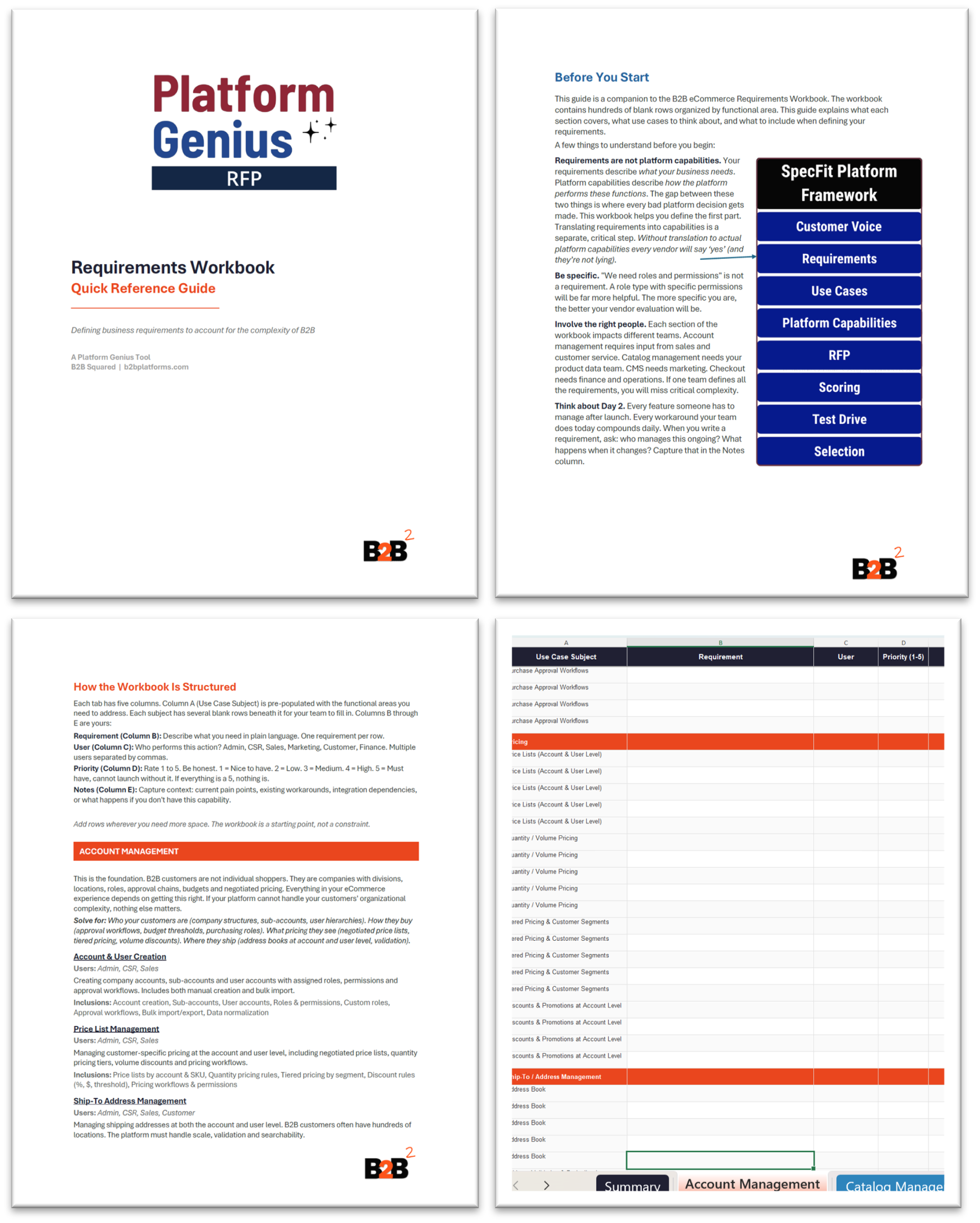
The same process we use for every Platform Genius RFP — FREE. Complete with handbook and workbook, it’s the critical step for mapping your complex customers and business rules to platform capabilities. The first three stages of the framework, structured for self-service.
Platform Genius RFP vs DIY: Want to talk about the best approach for you? Book a discovery call.